Back to Blog Home Page

Candidate A and Candidate B look identical on paper—same skills, same experience, same qualifications. The only difference? Candidate B’s profile is completely fake.
AI has transformed hiring for the better—think streamlined workflows, faster insights, stronger signals—but it has also exacerbated one of the most urgent challenges TA teams now face: candidate fraud.
At Employ, I see firsthand how this is playing out across the hiring funnel. And in conversations with TA leaders, the same themes and questions keep coming up—which is why I sat down with ProboTalent CEO Anthony Petraco to address them head-on.
Here’s a quick snapshot of our conversation, centered on the top five questions TA leaders have about candidate fraud.
Question #1: Is candidate fraud something every TA team needs to be worrying about now?
Short answer: yes. Candidate fraud isn’t a problem for tomorrow—it’s a very real challenge facing TA teams today (even for those using modern recruiting software and talent acquisition software).
According to our research in the 2025 Recruiter Nation Report, 23% of TA pros have already encountered candidate fraud, while Resume Genius reports that 17% of hiring managers have experienced deepfake technology during interviews. And the risk is only rising.
As I noted in the clip, “It’s getting harder and harder for recruiters and hiring managers to evaluate a candidate’s true skills and real abilities in a world where AI is used to create the most attractive resume for every job application.”
For recruiters on the front lines, candidate fraud isn’t a hypothetical scenario—it’s becoming part of daily reality inside applicant tracking systems and ATS applicant tracking systems, in interviews, and across the hiring funnel.
One of the biggest pressure points? AI-enhanced resumes “This ranges from harmless massaging of experience bullet points to amended job titles to be more in line with the desired role to just completely fake experience that never existed for that candidate.”
And the consequences aren’t theoretical. Fraudulent candidates can expose organizations to compliance risks, financial penalties, reputational damage, and significant time loss without proper background screening tools and background verification software.
Even more critically: every minute spent sorting through deceptive applications is time that could have been invested in real, high-quality talent.
Question #2 What does candidate fraud look like across the hiring funnel?
Candidate fraud takes many forms—some more obvious; others highly sophisticated. Increasingly, it is showing up in the following ways:
- Overemployment
- Spoofed/AI-Fabricated Resumes
- Fake References/Identity Masquerading
- Keyword Stuffing/Hidden Text Manipulation
- System Gaming (Automation, Bots, Scripts)
- Crowdsourced Cheating
As candidates advance through interviews, the nature of fraud shifts from subtle misrepresentation to more deliberate deception:
- Some may exploit loopholes in resume-matching systems by hiding keywords or embedding AI prompts.
- While fake references and identity swaps are becoming more common.
- At the far end of the spectrum, bots, scripts, and crowdsourced cheating give fraudulent candidates the tools to outsmart traditional screening steps.
And the deeper these fraudulent candidates make it into the funnel? The more risk your organization is exposed to.
Here’s how we describe the rising risk inside the funnel:
“At different points in the candidate pipeline, candidate fraud poses more risk and less risk to your organization. At the top of the funnel, while candidate fraud costs a lot of recruiter time, the risk to your organization is still relatively low from a fraud standpoint. The potential candidate or fraudster hasn’t spoken to multiple people throughout your organization yet or had the opportunity to directly deceive the hiring team.”
But that changes quickly:
“As you move into screening and interview stages, the stakes start to get higher for your organization. A potential fraudster is gaining access to more and more people and resources in your organization…to learn as much as they can to continue to make inroads towards getting what they’re ultimately looking for.”
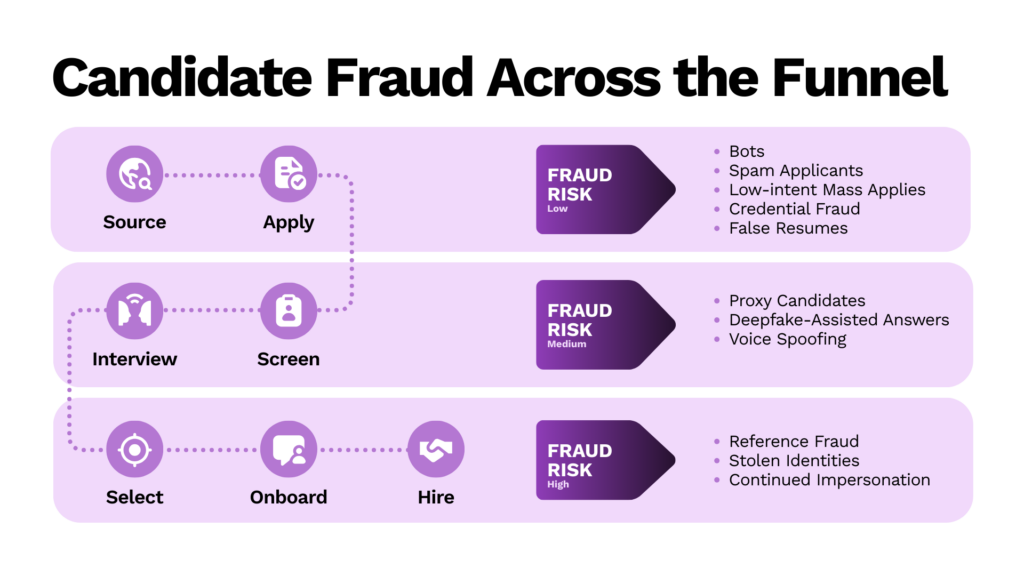
And the result? The closer a fraudulent candidate gets to a hiring decision, the greater the operational, financial, and reputational risk becomes.
Question #3 What strategies actually work to prevent and mitigate candidate fraud?
When it comes to fraud mitigation, there is no one-size-fits-all solution, even with AI tools for talent acquisition supporting many teams. Different stages of the funnel carry different levels of risk—and each requires its own set of defenses.
The most effective approach is a layered one. At Employ, we often refer to this as the Swiss Cheese methodology: individual layers have gaps, but when stacked together, those holes get smaller and smaller, creating a stronger, more resilient defense.
So, what does that look like in practice?
“At the top of the funnel, that looks like bot detection, smart screening, knockout logic, checking different aspects of the application—maybe against LinkedIn or other online presence.”
These early layers help filter out low-intent or automated applications without introducing unnecessary friction for legitimate candidates. Check out how and why assessments can help highlight the right candidates while filtering out the fraud:
However, as candidates move further down the funnel, the safeguards need to strengthen.
Mid-funnel tactics focus on identity consistency and ensuring the person actually showing up to the interview is the same person who applied.
“When you move further mid-funnel, it becomes more critical to deploy some additional defenses. Consistency checks for impersonation throughout each interview and comparing who you see—and potential deepfakes—they all become more critical.”
Question #4 How can we protect the hiring pipeline while still delivering a great candidate experience?
When it comes to mitigating candidate fraud, striking the right balance is critical. Teams need guardrails to protect their hiring pipeline. However, too many checks? And your qualified candidates get frustrated and drop out of the process.
Critically, “We believe in inclusive fraud prevention, ensuring that you’re executing fraud prevention in a way that’s equitable for all backgrounds, and values diversity—and it should be frictionless. It can’t seem cumbersome to the candidate, or you risk losing out on great talent.”
With that perspective in mind, one area worth a closer look: how identity verification is applied across the hiring process. Here’s a quick look at why thoughtful, staged verification is essential for both trust and inclusion:
And as Anthony pointed out later in our discussion, “Research, such as the State of Skills-Based Hiring report, indicates that a majority of candidates—particularly those from diverse backgrounds—prefer processes that allow them to demonstrate their skills directly. They perceive these methods as significantly fairer than traditional resume screening, which is often prone to unconscious bias.”
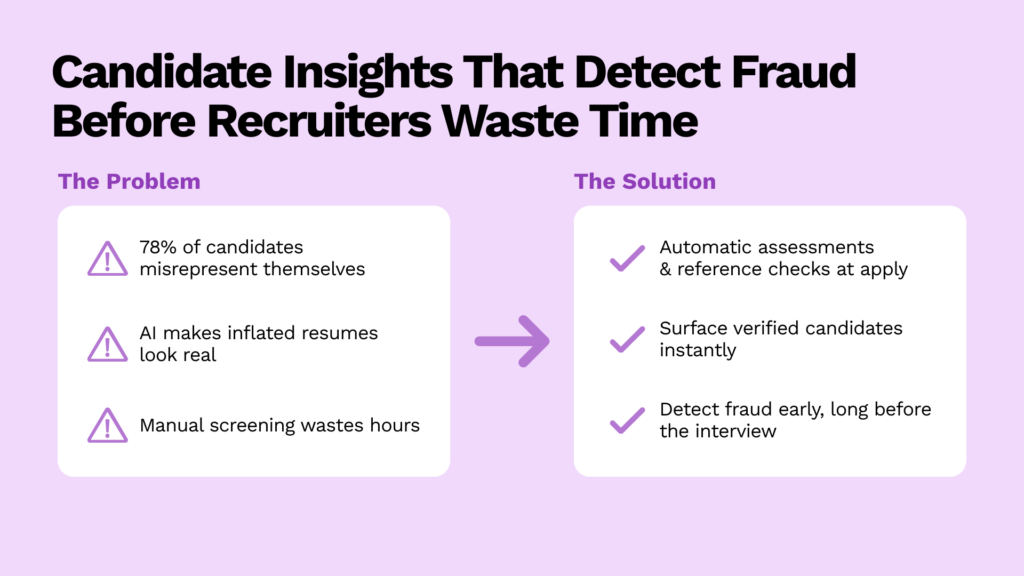
That’s why early, low-friction validation matters: it helps real candidates rise to the top—without creating friction where it doesn’t belong.
Question #5 As candidates incorporate more AI use in their job searches, how do we distinguish acceptable use from fraudulent behavior?
For every organization, acceptable AI use during the hiring and interview process will look a little different. One team may welcome certain tools, while another may expect candidates not to use AI at all.
What matters most is setting clear expectations—what’s allowed, what’s not, and exactly where you draw the line between responsible use and fraudulent behavior.
One standout example comes from our client DREAM Charter School. The way they incorporate AI into their hiring process—and how transparently they communicate expectations on both sides of the interview table—is a master class (pun intended) for organizations across industries:
In short, “Our recommendation is that you use space on your career site or in your job description to clearly lay out for the candidate what is and is not cheating when it comes to AI. At that point, if you do catch someone using an AI assistant in an interview, you can clearly communicate to them that they were cheating without fear of any legal retribution from the candidate.”
Tackling Candidate Fraud Before Risk Becomes a Reality
So, what does all of this mean for your strategy today—and how should it shape your approach heading into 2026?
Here are a few practical takeaways you can start applying now to strengthen your defenses both immediately and over the long term:
- Define your stance on candidate AI use—and publish it. Set clear expectations for what’s allowed, what’s not, and how you’ll evaluate it. Additionally, clearly state how your team uses AI within the hiring process.
- Add low-friction fraud checks at the top of the funnel. Even a small step—like a knockout question sent separately of the initial application—helps filter low-intent or fraudulent applicants.
- Train hiring managers on interview fraud signals. Run consistency checks across interviews to confirm the same person is showing up and flag any signs of impersonation or deepfakes.
- Revisit ID verification timing. Balance diversity and inclusivity considerations with risk by using phased verification instead of an all-or-nothing approach.
- Audit your pipeline for vulnerability. Identify where fraud could cause the most damage—top, mid, or offer stage—and layer defenses accordingly.
At the end of the day, fraud prevention is about protecting both your team and the real candidates who want to work with you. That’s why at Employ, we focus on layered, responsible safeguards backed by IBM watsonx.governance to ensure fairness and trust.
Because hiring works best when it stays responsible, transparent, and deeply human.